
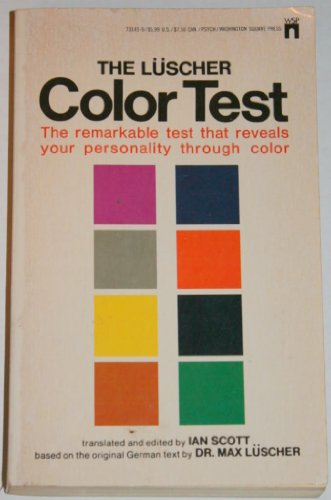
The Luscher Color Test
1990
•
Max Lüscher
Plus d'infos
Summary
The principle of the Lüscher Color Test is that psychological information can be gained through selections & rejections of colors. A simplified version of the test may be taken & interpreted quickly. Laypersons can self-administer it, even before reading the book. In fact, it's advisable: reading the text beforehand may prejudice color selections. By following the instructions on pages I-III, which explain how to use the eight bound-in color cards & the Interpretation Tables, readers will find how psychologically revealing color choices can be.
Preliminary Instructions
Preliminary Interpretation
Instructions for Conducting the Test
Color Psychology: The origin of color significance
The physiology of color
The development of color vision
"Color blindness" makes no difference
The Lüscher test
Functional Psychology: The significance of the eight positions
Interpreting the functions
The basic & auxiliary colors: Color-coding of the eight colors
Categories of the four basic colors
Combined basic colors
Basic colors should be preferred
The auxiliary colors
Grouping & marking the 8-color sequence
Anxieties, compensations & conflicts: Stress-sources
Compensations
Exaggerated compensations
Intensity of the anxiety & compensation
Prognosis
Summary of rules for marking anxieties & compensations
The "actual problem"
Ambivalence
The rejected or suppressed characteristic
"Emotional" personalities
Conflict between objective & behavior
Instability of the autonomic nervous system
Work & exhaustibility
The meaning of the eight colors
Grey
Blue
Green
Red
Yellow
Violet
Brown
Black
Structural meaning of the color pairs
Test interpretation: A word of warning
Examples of test analyses
Interpretation Tables
Appendices
Literature about the Lüscher Color Test

