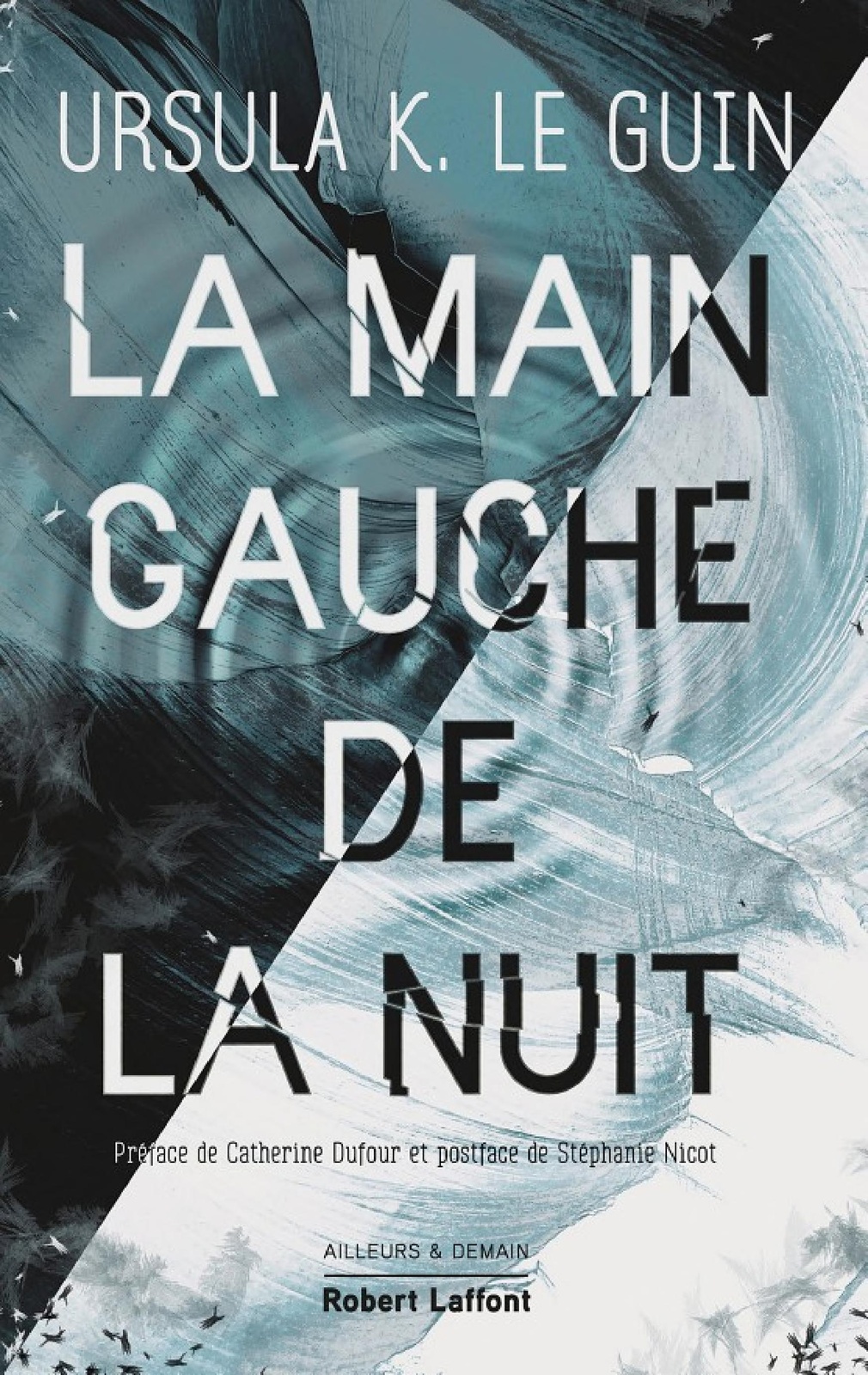
The Left Hand Of Darkness
2012
•
Ursula K. Le Guin


Plus d'infos
Summary
Winter is an Earth-like planet with two major differences: conditions are semi artic even at the warmest time of the year, and the inhabitants are all of the same sex. Tucked away in a remote corner of the universe, they have no knowledge of space travel or of life beyond their own world. And when a strange envoy from space brings news of a vast coalition of planets which they are invited to join, he is met with fear, mistrust and disbelief . . . 'The Left Hand of Darkness' is a groundbreaking work of feminist science fiction, an imaginative masterpiece which poses challenging questions about sexuality, sexism and the organisation of society.
Avis et Commentaires
2 avis
Ursula J. Le Guin (1969) The Left Hand of Darkness is a science fiction novel by the American writer Ursula K. Le Guin. Published in 1969, it became immensely popular, and established Le Guin's status as a major author of science fiction.[7] The novel is set in the fictional Hainish universe as part of the Hainish Cycle, a series of novels and short stories by Le Guin, which she introduced in the 1964 short story "The Dowry of Angyar". It was fourth in sequence of writing among the Hainish novels, preceded by City of Illusions, and followed by The Word for World Is Forest.[4] The novel follows the story of Genly Ai, a human native of Terra, who is sent to the planet of Gethen as an envoy of the Ekumen, a loose confederation of planets. Ai's mission is to persuade the nations of Gethen to join the Ekumen, but he is stymied by a lack of understanding of their culture. Individuals on Gethen are ambisexual, with no fixed sex; this has a strong influence on the culture of the planet, and creates a barrier of understanding for Ai. The Left Hand of Darkness was among the first books in the genre now known as feminist science fiction and is described as the most famous examination of androgyny in science fiction.[8] A major theme of the novel is the effect of sex and gender on culture and society, explored in particular through the relationship between Ai and Estraven, a Gethenian politician who trusts and helps Ai. When the book was first published, the gender theme touched off a feminist debate over the depiction of the ambisexual Gethenians. The novel also explores the interaction between the unfolding loyalties of its two main characters, the loneliness and rootlessness of Ai, and the contrast between the religions of Gethen's two major nations. The Left Hand of Darkness has been reprinted more than 30 times,[9] and received high praise from reviewers. In 1970, it was voted the Hugo and Nebula Awards for Best Novel by fans and writers, respectively, and was ranked as the third best novel, behind Frank Herbert's Dune and Arthur C. Clarke's Childhood's End, in a 1975 poll in Locus magazine.[10] In 1987, Locus ranked it second among science fiction novels, after Dune,[11] and literary critic Harold Bloom wrote, "Le Guin, more than Tolkien, has raised fantasy into high literature, for our time".[9] Background Le Guin's father Alfred Louis Kroeber and mother Theodora Kroeber were scholars, and exposure to their anthropological work considerably influenced Le Guin's writing.[12][13] The protagonists of many of Le Guin's novels, such as The Left Hand of Darkness and Rocannon's World, are also anthropologists or social investigators of some kind.[14] Le Guin used the term Ekumen for her fictional alliance of worlds, a term coined by her father, who derived it from the Greek oikoumene to refer to Eurasian cultures that shared a common origin.[15] Le Guin's interest in Taoism influenced much of her science fiction work. According to academic Douglas Barbour, the fiction of the Hainish universe (the setting for several of Le Guin's works) contain a theme of balance between light and darkness, a central theme of Taoism.[16] She was also influenced by her early interest in mythology, and her exposure to cultural diversity as a child. Her protagonists are frequently interested in the cultures they are investigating, and are motivated to preserve them rather than conquer them.[17] Authors who influenced Le Guin include Victor Hugo, Leo Tolstoy, Virginia Woolf, Italo Calvino, and Lao Tzu.[18] Le Guin identified with feminism, and was interested in non-violence and ecological awareness. She participated in demonstrations against the Vietnam War and nuclear weapons. These sympathies can be seen in several of her works of fiction, including those in the Hainish universe.[18] The novels of the Hainish cycle frequently explore the effects of differing social and political systems, although according to lecturer Suzanne Reid, Le Guin displayed a preference for a "society that governs by consensus, a communal cooperation without external government".[19] Her fiction also frequently challenges accepted depictions of race and gender.[19] The original 1969 edition of The Left Hand of Darkness did not contain an introduction. After reflecting on her work, Le Guin wrote in the 1976 edition that the genre of science fiction was not as "rationalist and simplistic" as simple extrapolation. Instead, she called it a "thought experiment" which presupposes some changes to the world, and probes their consequences.[20] The purpose of the thought experiment[20] is not to predict the future, but to "describe reality, the present world".[20] In this case, her thought experiment explores a society without men or women, where individuals share the biological and emotional makeup of both sexes.[19] Le Guin has also said that the genre in general allows exploration of the "real" world through metaphors and complex stories, and that science fiction can use imaginary situations to comment on human behaviors and relationships.[18] In her new introduction to the Library of America reprint in 2017, the author wrote: Up until 1968 I had no literary agent, submitting all my work myself. I sent The Left Hand of Darkness to Terry Carr, a brilliant editor newly in charge of an upscale Ace paperback line. His (appropriately) androgynous name led me to address him as Dear Miss Carr. He held no grudge about that and bought the book. That startled me. But it gave me the courage to ask the agent Virginia Kidd, who had praised one of my earlier books, if she’d consider trying to place The Left Hand of Darkness as a hardcover. She snapped it up like a cat with a kibble and asked to represent me thenceforth. She also promptly sold the novel in that format. I wondered seriously about their judgment. Left Hand looked to me like a natural flop. Its style is not the journalistic one that was then standard in science fiction, its structure is complex, it moves slowly, and even if everybody in it is called he, it is not about men. That's a big dose of "hard lit," heresy, and chutzpah, for a genre novel by a nobody in 1968.[21] Setting The Left Hand of Darkness is set in the fictional Hainish universe, which Le Guin introduced in her first novel Rocannon's World, published in 1966. In this fictional history, human beings did not evolve on Earth, but on Hain. The people of Hain colonized many neighboring planetary systems, including Terra (Earth) and Gethen, possibly a million years before the setting of the novels. Some of the groups that "seeded" each planet were the subjects of genetic experiments, including on Gethen.[20] The planets subsequently lost contact with each other, for reasons that Le Guin does not explain.[22] Le Guin does not narrate the entire history of the Hainish universe at once, instead letting readers piece it together from various works.[23] The novels, and other fictional works set in the Hainish universe, recount the efforts to re-establish a galactic civilization. Explorers from Hain as well as other planets use interstellar ships traveling nearly as fast as light. These take years to travel between planetary systems, although the journey is shortened for the travelers due to relativistic time dilation, as well as through instantaneous interstellar communication using the ansible, a device invented during the events described in The Dispossessed.[22] This galactic civilization is known as the "League of All Worlds" in works set earlier in the chronology of the series, and has been reconstructed as the "Ekumen" by the time the events in The Left Hand of Darkness take place.[22] During the events of the novel, the Ekumen is a union of 83 worlds, with some common laws.[23] At least two "thought experiments" are used in each novel. The first is the idea that all humanoid species had a common origin; they are all depicted as descendants of the original Hainish colonizers. The second idea is unique to each novel.[20] The Left Hand of Darkness takes place many centuries in the future—no date is given in the book itself. Reviewers have suggested the year 4870 AD, based on extrapolation of events in other works, and commentary on her writing by Le Guin.[4] The protagonist of the novel, the envoy Genly Ai, is on a planet called Winter ("Gethen" in the language of its own people) to convince the citizens to join the Ekumen. Winter is, as its name indicates, a planet that is always cold.[24] The inhabitants of Gethen are ambisexual humans; for twenty-four days (a period called somer in Karhidish, a Gethenian language) of each twenty-six-day lunar cycle, they are sexually latent androgynes. They only adopt sexual attributes once a month, during a period of sexual receptiveness and high fertility, called kemmer. During kemmer, they become sexually male or female, with no predisposition towards either,[25] although which sex they adopt can depend on context and relationships.[7] Throughout the novel Gethenians are described as "he", whatever their role in kemmer. This absence of fixed gender characteristics led Le Guin to portray Gethen as a society without war, and also without sexuality as a continuous factor in social relationships.[25][24] On Gethen, every individual takes part in the "burden and privilege" of raising children, and rape and seduction are almost absent.[24] Plot summary The protagonist of the novel is Genly Ai, a male Terran native, who is sent to invite the planet Gethen to join the Ekumen, a coalition of humanoid worlds.[26] Ai travels to the Gethen planetary system on a starship which remains in solar orbit with Ai's companions, who are in stasis; Ai himself is sent to Gethen alone, as the "first mobile" or Envoy. Like all envoys of the Ekumen, he can "mindspeak"—a form of quasi-telepathic speech, which Gethenians are capable of, but of which they are unaware.[27] He lands in the Gethenian kingdom of Karhide, and spends two years attempting to persuade the members of its government of the value of joining the Ekumen. Karhide is one of two major nations on Gethen, the other being Orgoreyn.[b] The novel begins the day before an audience that Ai has obtained with Argaven Harge, the king of Karhide. Ai manages this through the help of Estraven, the prime minister, who seems to believe in Ai's mission, but the night before the audience, Estraven tells Ai that he can no longer support Ai's cause with the king. Ai begins to doubt Estraven's loyalty because of his strange mannerisms, which Ai finds effeminate and ambiguous. The behavior of people in Karhide is dictated by shifgrethor, an intricate set of unspoken social rules and formal courtesy. Ai does not understand this system, thus making it difficult for him to understand Estraven's motives, and contributing to his distrust of Estraven.[28] The next day, as he prepares to meet the King, Ai learns that Estraven has been accused of treason, and exiled from the country. The pretext for Estraven's exile was his handling of a border dispute with the neighboring country of Orgoreyn, in which Estraven was seen as being too conciliatory. Ai meets with the king, who rejects his invitation to join the Ekumen.[29] Discouraged, Ai decides to travel through Karhide, as the spring has just begun, rendering the interior of the frozen country accessible. Ai travels to a Fastness, a dwelling of people of the Handdarata, one of two major Gethenian religions. He pays the fastness for a foretelling, an art practiced to prove the "perfect uselessness of knowing the answer to the wrong question".[30][31] He asks if Gethen will be a member of the Ekumen in five years, expecting that the Foretellers will give him an ambiguous response, but he is answered "yes". This leads him to muse that the Gethenians have "trained hunch to run in harness".[32] After several months of travelling through Karhide, Ai decides to pursue his mission in Orgoreyn, to which he has received an invitation. Ai reaches the Orgota capital of Mishnory, where he finds that the Orgota politicians are initially far more direct with him. He is given comfortable quarters, and is allowed to present his invitation to the council that rules Orgoreyn. Three members of the council, Shusgis, Obsle, and Yegey, are particularly supportive of him. These three are members of an "Open Trade" faction, which wants to end the conflict with Karhide. Estraven, who was banished from Karhide, is found working with these council members, and tells Ai that he was responsible for Ai's reception in Orgoreyn.[33] Despite the support, Ai feels uneasy. Estraven warns him not to trust the Orgota leaders, and he hears rumors of the "Sarf", or secret police, that truly control Orgoreyn. He ignores both his feeling and the warning, and is once again blindsided; he is arrested unexpectedly one night, interrogated, and sent to a far-northern labor camp where he suffers harsh cold, is forced into hard labor, and is given debilitating drugs. He becomes ill and his death seems imminent. His captors expect him to die in the camp, but to Ai's great surprise, Estraven—whom Ai still distrusts—goes to great lengths to save him. Estraven poses as a prison guard and breaks Ai out of the farm, using his training with the Handdarata to induce dothe, or hysterical strength, to aid him in the process. Estraven spends the last of his money on supplies, and then steals more, breaking his own moral code. The pair begin a dangerous 80-day trek across the northern Gobrin ice sheet back to Karhide, because Estraven believes that the reappearance of Ai in Karhide will convince Karhide to accept the Ekumen treaty, knowing that Karhide will want the honor of doing so before Orgoreyn. Over the journey Ai and Estraven learn to trust and accept one another's differences. Ai is eventually successful in teaching Estraven mindspeech; Estraven hears Ai speaking in his mind with the voice of Estraven's dead sibling and lover Arek,[34] demonstrating the close connection that Ai and Estraven have developed. When they reach Karhide, Ai sends a radio transmission to his ship, which lands a few days later. Betrayed by a friend with whom the two were hiding, Estraven tries to cross the land border back into Orgoreyn, fearing pursuit, but is killed by border guards, who also capture Ai. Estraven's prediction is borne out when Ai's presence in Karhide triggers the collapse of governments in both Karhide and Orgoreyn—Orgoreyn's because its claim that Ai had died of a disease was shown to be false. Karhide agrees to join the Ekumen, followed shortly by Orgoreyn, completing Ai's mission